


Our History
“I had a barge ready at Tower-wharfe, to take us in, and so we went, all of us, up as high as Barne-Elms, a very fine day, and all the way sang.” — Samuel Pepys, Diary, 23 March 1667
Before bridges, before organised sport, before cinemas, wetlands, or suburban Barnes, there was the Manor — and beyond it, the carefully shaped and guarded landscape of Barn Elms.
Recorded as early as 1540 it formed part of the manor of Barnes, land held for centuries by St Paul’s Cathedral. It was never empty ground. It was a place of power, intention, intrigue and social drama, home to Chancellors and Elizabethan spymasters, visited by royalty, poets and political thinkers, and a retreat for figures at the heart of national life. Its riverside mansion and estate hosted statesmen, writers and courtiers, entertained kings, queens and composers, and even witnessed duels fought between dukes and earls amid scandal and secrecy.
The derelict manor was badly damaged in a fire and finally demolished in 1954 — but for centuries it shaped this place. By the mid-18th century, Barn Elms was an estate of around 480 acres: mansion house, outbuildings, pleasure gardens, pasture, farmland, meadows, fishponds, willow grounds and riverbanks drawn into a deliberate whole.
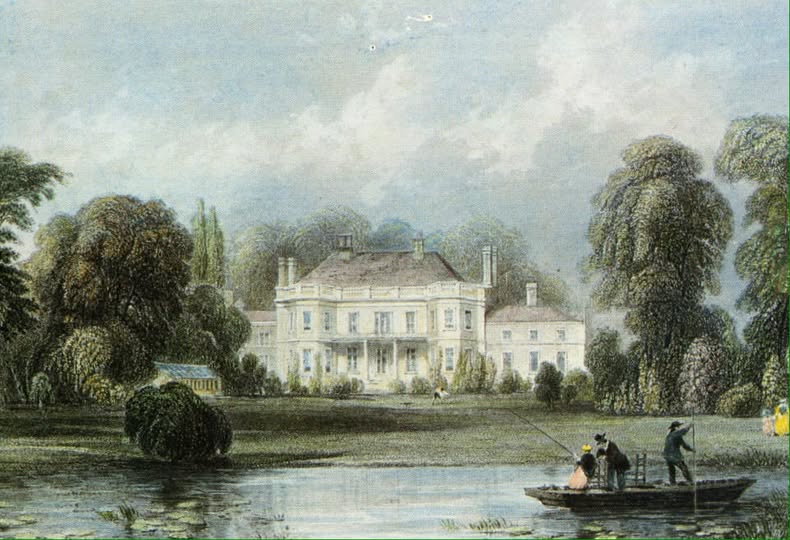
The Rear View of Barn Elms manor painted by Thomas Allen 1840
The Manor controlled land, tenancy, work and obligation. It drew people to its boundaries: labourers, servants, tenants, traders, visitors. And at the edge of that authority, just outside its gate and on its fringe, something else appeared — as it so often did across England — a place away from the formal gaze of the great house.That place became known as the Strugglers.
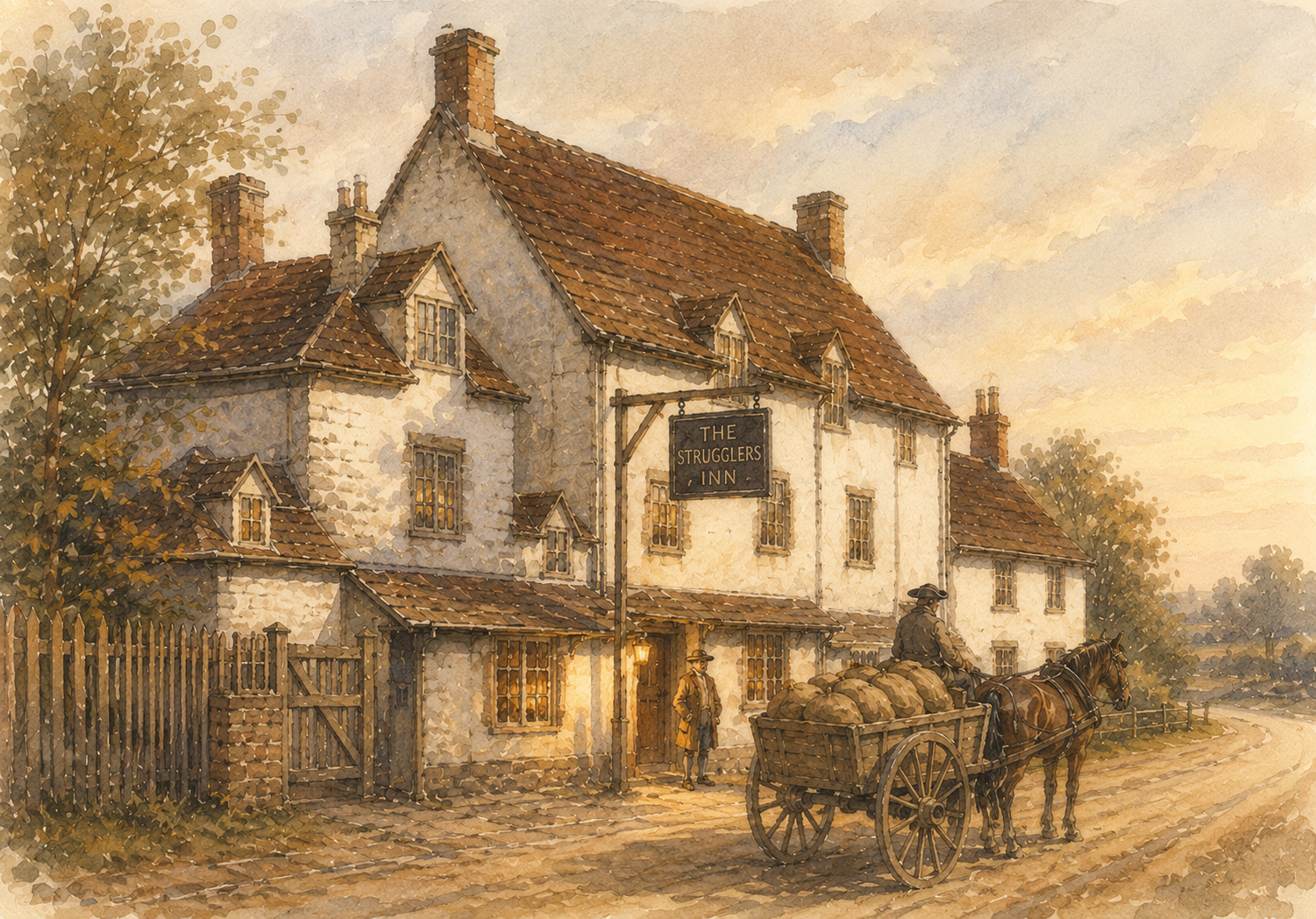
AI-assisted artist's impression inspired by the c.1772 drawing of The Strugglers/The Red Lion, by Samuel Hieronymus Grimm.
First recorded as a licensed public house in 1718 the name was not metaphorical. It described lives lived close to the land and the river. Farmers & market gardeners working the fertile ground around Barnes. Ferrymen and river workers moving people and goods along the Thames. Carters and travellers passing through between London and the west. Seasonal workers. People whose days were shaped by weather rather than clocks.
Nearby, on Mill Hill, stood a mill, and below it, barns sat among the elm trees where grain was stored before moving onward. These were not daily spectacles at the alehouse door, but part of the wider working landscape — quiet evidence that this was a place of production, movement, and necessity rather than leisure.The alehouse served them all. It offered shelter, refuge, drink, warmth, news, hiring contacts, argument, and rest. Close enough to the Manor to serve its orbit, but far enough away to escape its eye. This was an old, reliable arrangement. Pubs survive best not at the centre of power, but just beyond it.
After a fire in 1835, the Strugglers was rebuilt and renamed the Red Lion. Its Georgian shell was practical and domestic, because its purpose did not yet demand grandeur. For decades it carried on much as before — steady rather than ambitious — reflecting the life around it. It did not fail or flourish dramatically; it endured. It “bumbled along” because the rhythms of Barnes itself were still loose, rural, and seasonal.The Thames continued to draw people here — not as spectacle, but as relief. Paths along the river carried walkers then as they do now. Fields remained open. People arrived having moved, worked, or wandered, and they needed somewhere to come down again.
The great shift came in 1887, the rebuilt Hammersmith Bridge (1887) made Barnes reliably reachable. Castelnau ceased to be merely a way through and became a place to arrive. Barnes tightened into suburbia. Organised leisure followed. The transformation of Barn Elms into a centre of organised sport — most notably the Ranelagh Club (1884–1939) — brought regular,
weather-proofed footfall: polo players, golfers, tennis players, spectators, staff and visitors. Fields were played on in all seasons. even hot air ballooning! Playing fields formalised games that had long been played in rougher forms.The pattern became clear and reliable, exertion outside, fellowship afterwards.
The opening of Byfeld Hall in 1906 brought a new evening rhythm to Barnes, drawing civic society and culture into the village. When events ended, the Red Lion became the natural place to continue the conversation — where formality eased into fellowship, quietly reinforcing the pub’s role as the social hinge of Edwardian Barnes.
It was during these Ranelagh and Byfeld Hall boom years that Cannon Brewery took the Red Lion into its estate.
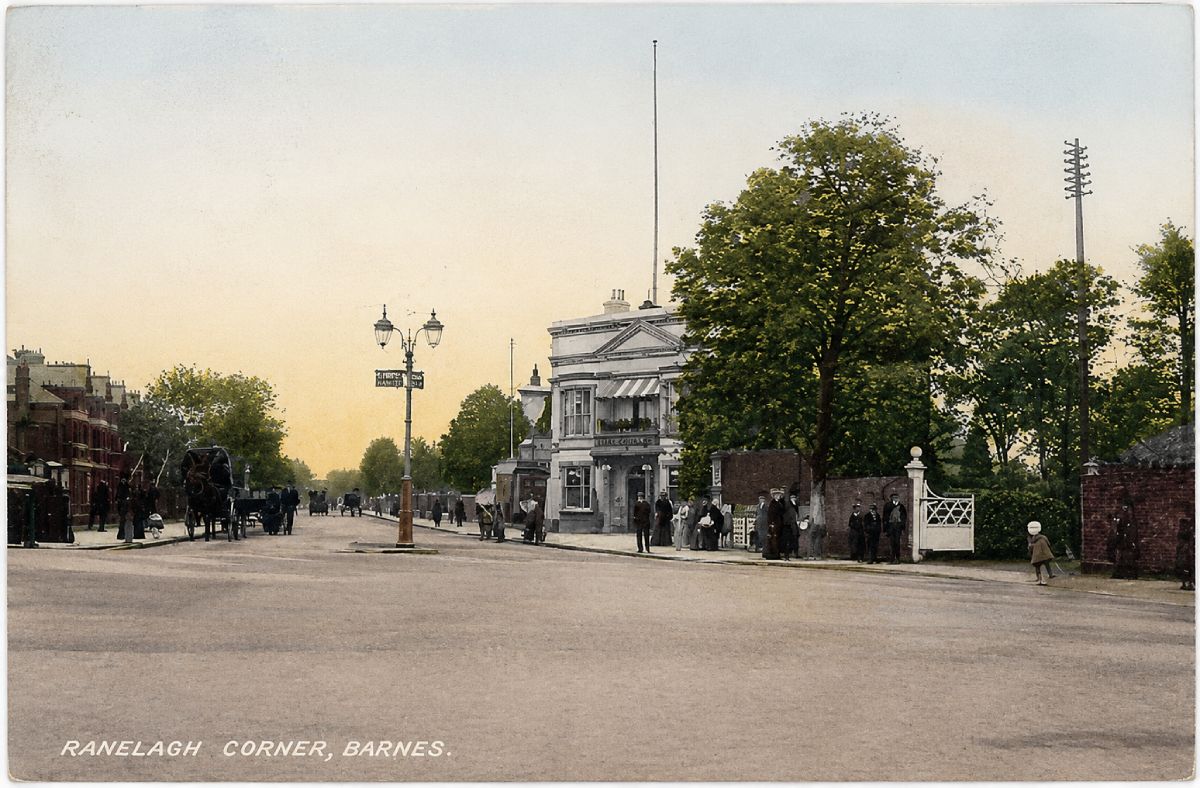
Ranelagh Corner/Red Lion Hotel 1904
Cannon, the Clerkenwell Brewer, did not create the pub and did not overwrite its past. They recognised that it already sat at the centre of a living ecosystem. Their investment refined what was there: strengthening the interior, complimenting the waterside retreat, enlarging and dignifying spaces, turning a plain house into a comfortable and special, suburban pub — respectable without being exclusive, ordinary without being mean. That original spirit endures, sustained today through Fuller’s thoughtful stewardship.
Crucially, it served both the common man and the growing middle class together. Cannon understood what generations of keepers had learned by instinct: a pub that serves only labour becomes fragile; a pub that serves only aspiration becomes hollow. Survival lies in the space between.
As the years passed, the ecosystem shifted but never broke.
The river walks remained. The fields continued to be played on, rain or shine. Sporting people still finished in the pub — muddy, cold, hoarse, triumphant or beaten. Byfeld Hall’s communal role echoes today in The Olympic Cinema, releasing people from shared experience into the night, looking for somewhere to settle. Barn Elms’ long openness finds its modern expression in The London Wetlands Centre and surroundings — space to slow down, watch, and breathe.
The Manor is gone, but its logic remains. This is still an edge — between city and country, effort and ease, movement and rest, a place where one comes to linger.
And the pub remains the keystone.
The Red Lion has always been a hub, a magnet, a glue — not because it dominates the landscape, but because it receives it. A place where people can arrive without explanation, where lives briefly overlap, and where it is permitted simply to be.
It began as a quiet threshold at a manor’s edge — a place for pause and gathering. It grew as people passed through it, talked within it, and claimed it as their own. And it endures now not because it was saved, but because it has never stopped being needed.
That is the Red Lion’s story — grounded, porous, and enduring.
To be continued.........
